Sunday, May 26, 2013

Mash Em Up!

I am a huge fan of genre mash-ups.  I think it's because they're so rare these days and also because they're almost always fish-out-of-water stories.  There's nothing wrong with a straight-up horror story or a comedy or western, or whatever.  But mix them together and the result can be very entertaining.  It can elevate a so-so story if done correctly.  My novel The Last Battleship was something of a mash-up in that I tried to blend war and horror together.  Hopefully I succeeded.  We don't get enough of these type of stories and I think we're the poorer for it.  The commercial entertainment industry is too wimpy to take many chances.  Oh, we get the sci fi/horror mash-up all the time but beyond that...not too much.   
 
This isn't a new idea but it's done so rarely it seems like it is.  I think that's why Cowboys and Aliens (2011)  did so well at the box office. 


The pitch must have been something like this:  "Take a western and mix in some sci fi."  It was okay.  It had some genuinely entertaining scenes.  And there's no arguing with the awesomeness of uniting Indiana Jones and James Bond to battle some ridiculous alien gold prospectors.  But from a storytelling standpoint the movie was horrible.  That didn't seem to matter and I hope its success will at least make more producers less skittish about crossing genres. 
 
Look what James Cameron did with Aliens (1986).  It's a sequel to one of the greatest horror movies of all time but it's not quite a horror movie.  Oh, it's scary as hell, don't get me wrong; but it's difficult to categorize it as a straight-up horror movie.  It takes place on another planet and deals with an alien adversary.  So is it sci fi?  To me it's always been a war movie with horror undertones.  I think it qualifies as a mash-up of war and horror with a bit of sci fi added in for flavor.  I mean, does this image make you think "horror" or "war"? 
 

For me this is a war movie that makes use of horror movie tropes.  This does not diminish anything about it as far as I'm concerned.  It's probably in my top ten favorite movies of all time.  On paper it could have been just as effective if the aliens were replaced by a superior (human) enemy force.  I don't know if that would have been as good but I can see how it could have been done.
 
As I'm writing this it occurs to me that, next to sci fi/horror, the next most popular genre mash-up must be war/horror.  You can make the point that all war stories are horror stories and I would not argue.  It's difficult if not impossible to watch the first 20 minutes of Saving Private Ryan (1998) or most of Black Hawk Down (2001) and not be scared shitless.  But those movies/books don't use supernatural horror and that's where I draw the distinction.  There are still a few examples I can point to where someone got their war mixed with somebody else's horror and discovered two great tastes that taste great together.   
 
In a previous blog I talked about horror comic books.  Some of these, like Swamp Thing and Ghost Rider, mixed horror and super heroes together.  There are other examples.  Sticking with war/horror one last time, DC gave us Weird War Tales.  It ran longer than I thought it did, from 1971-1983.  A solid twelve years and 124 issues.  Not bad.  I have some of them, including #1.  The issues in my collection are entertaining and I wouldn't mind completing my collection of that title.  By and large they got it right. 
 

I'm less enthusiastic when genres I don't care about are combined, although I applaud the creators for trying something different.  Romcoms, paranormal romance, dramedies, etc.  Not really my cup of early grey but at least someone's taking a chance.  I can respect that even if the genres don't interest me.
 
A couple more examples before we get out of here and hit the local watering hole. I want to mention two examples of genre mash-ups that not many people think of as such.  They're both quite famous, actually.  I'm talking worldwide famous.  The first is Superman, created in 1938 by Jerry Siegel and Joe Shuster and published ever since by DC Comics. 
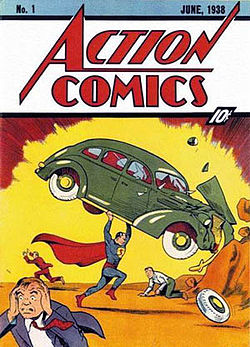


Of course everyone knows Superman is a super hero.  That's where the term "super hero" comes from.  You probably even knew that.  But he mashes super heroes and science fiction better than any other character in literature.  In fact, in terms of money generated over time, I'm willing to bet Superman is the all-time champion of genre mash-ups.  He is a "strange visitor from another planet!" as the opening naration in the old TV show with George Reeves informed us.  An alien visitor?  What's more sci fi than that?  What enables Superman to be super is the yellow sun of earth.  On Krypton he would have been no more super than Jimmy Olson is here.  Yes, the science is a little on the iffy side but that's okay.  So are warp drive and lightsabres and we accept those.
 
And the last example is one I guarantee not many people would consider a genre mash-up and I'm about to prove how wrong they are.  I'm talking about that most beloved of holiday classics, Charles Dickens' A Christmas Carol.  Stay with me.  It was first published in 1843 and it is ostensibly a story about personal redemption that happens to take place during the Christmas holiday.  But it's way more than that.  Take, for instance, the title page of the novel:
 

It says it right there:  "A ghost story of Christmas."  Since ghosts belong squarely in the horror/supernatural genre, it has just become much more than a simple holiday fable.  Scrooge is visited first by the ghost of his old partner and mentor, and then he sees three more ghosts before the story ends.  But there's more.  It is also undeniably a sci fi story.  I'll prove it. 
 
The three ghosts employ a plot device that is 100% science fiction:  time travel.  They take Scrooge into the distant past and the far future.  The Ghost of Christmas Present is the most sci fi of them all because not only does it take Scrooge ahead 12 hours to Christmas morning at Bob Cratchett's house, it even takes Scrooge a full year into the future to the following Christmas.  And this is where the sci fi elements of A Christmas Carol become in-yo-face.  It shows him an alternate future.  Scrooge discovers that Tiny Tim has not survived the year.  But at story's end, when Scrooge has his change of heart and joins the Cratchetts for Christmas dinner, Dickens flat-out tells us Tiny Tim will survive.  Time travel, alternate realties and ghosts define this novel as way more than a run of the mill drama.  It's a genre mash-up of the first order.  Good job, Mr. Dickens.
 
Now onto that watering hole I mentioned.  First round's on you. 


Friday, May 3, 2013

Funny Books? Not Always

I started reading comic books when I was 5 years-old, maybe even earlier.  I'm not entirely sure.  I also don't know which comic book I read first.  It was most likely a mainstream super-hero title like Superman, Amazing Spider-Man or maybe Justice League of America, bought by one of my grandfathers.  Again, I have no clear memory of this.  What I can tell you is whatever that first comic was it sparked an interest in the art form that has never abated.  I've been reading and collecting comics ever since.  How many do I have?  Glad you asked.  I'm closing in on 18,000.  What's the collection worth?  No idea.  I'm not interested in selling it so the question is irrelevant.  Moving on...
 
Comics encompass all genres.  Most people think of super-heroes when they hear the term "comic book" but that's selling the art form short.  Comics have included romance, western, sci fi, crime, funny animal, humor, war and, of course, horror.  The greatest of the horror comics were published in the 1950s by EC Comics, the brainchild of publisher William Gaines.  EC's horror output included classic titles like Tales From the Crypt, The Vault of Horror and The Haunt of Fear.  Sadly, I possess only a handful of these titles in collected form.  The originals are almost impossible to find and cost more than my car. 

In 1954 the Comics Code Authority was formed.  It was a self-censorship entity that decided, all on its own, that horror comics were no longer allowed.  This was in response to charges brought by Dr. Frederick Wertham that comics caused juvenile delinquency.  His findings, compiled in the book Seduction of the Innocent, were based on nothing more than his opinions.  (He demanded to know, for instance, why Batman, Robin and Alfred lived in the same house without any female companions.  Were they...gay???  DC responded by actually killing Alfred and replacing him with Aunt Harriet!  Now that's horror!)  And yet the United States Congress went right along with him.  It helps if you remember this was the era of McCarthyism and Communist witch hunts.  Americans were seeing enemies in every shadow and the rise in teen crime had to be blamed on something.  Comic books proved to be an easy target.  So the Code did away with vampires, werewolves, ghosts, etc.  It also did away with EC, more or less.  With the significant exception of Mad Magazine they were pretty much gone from the shelves.     
 

                                          Looks like good old-fashioned harmless entertainment to me.  
 
 
A quick digression:  The decade of the 1950s really was a great time to be a horror fan.  In addition to the brilliance that was EC's line there were literally dozens of wonderful horror movies to take in.  Most of the monsters/bad guys in these movies had some connection to science gone awry or outer space.  They had great titles like The Magnetic Monster and It! The Terror From Beyond Space and the like. We can enjoy these movies now but I wish I could have seen them first-run in the theatre.  It must have seemed like a new one was coming out every week.  End digression.

Fast forward to 1971.  The Comics Code, for reasons known only to them, decided horror comics were okay.  There were still restrictions on content but the first cracks in the dike had appeared.  The two biggest publisher at the time, Marvel and DC, leaped with both feet into the horror market, with mixed results.  Since this was around the time I started reading comics these titles hold a certain nostalgic charm for me so I can't badmouth them too much.  Objectively I can say some were very good and some sucked.  It happens.  But I like them all, even the lousy ones. 
 
DC had titles like Swamp Thing and The Witching Hour.  Marvel countered with Ghost Rider and Tomb of Dracula, among others.  Marvel even whipped up their own swamp monster, the gloriously named Man-Thing.  In 1975 when Marvel started putting out Giant-Size issues of most of their series, we were treated to the single greatest title in the history of comics:  Giant-Size Man-Thing.  And no one at Marvel seemed to think anything of it.  Or maybe they did and laughed when no one was looking.  See for yourself:
 
                    Yes, that's number FOUR.  As in, there were 3 issues with the same title published before this.
 
Here are some of the other horror titles from the era.  Some had a superhero slant to them, especially Ghost Rider but I don't blame the publishers for hedging their bets a little.  The fact is super-heroes were selling and not many people were sure this new wave of horror titles would catch on. 


A lot of these horror-based characters operated in their own dark corner of their respective universes.  Some, like Morbius the Living Vampire, first appeared in the mainstream Mavel Universe by showing up to fight Spider-Man in his first appearance.  This was both common and rare at the same time.  It was common because Spidey was Marvel's most popular character at the time and meeting him was a rite of passage for most new characters.  It was Marvel's way of letting the readers know this character was officially part of their shared universe.  It was rare, however, because horror characters did not usually show up in super-hero titles.

                                                  Yes, Spidey has six arms here.  Don't ask.     

I don't know what comics readers at the time thought of these new entries in the genre.  Like I said I was a newcomer when these were being published.  As far as I knew there had always been horror comics.  I didn't learn until years later that they were all pretty new concepts at the time.  So my timing was excellent.  Bully for me!

Once the Comics Code Authority opened the door a little they were never able to close it again.  Horror comics didn't last too long, though.  By the late-70s most of them were already gone.  A few titles soldiered on but for the most part the horror renaissance in comics was over.  Which is a shame because the Comics Code Authority itself gave up the (ahem) ghost a few years ago.  And it couldn't have died soon enough for me.  Some of the horror characters remain and they continue to pop up in stories from time to time.  Swamp Thing has his own monthly title again but it's not remotely a horror comic.  There are, however, several quality horror comics being published right now.
 
Avatar has the comics rights to Romero's Night of the Living Dead and they're having a blast with it.  The cover of this issue would fit right in with what EC was doing 60 years ago:


The stories are definitely not for children.  These are as R-rated as you can get.  Nothing wrong with that, just pointing it out in case you're considering letting little Johnny or Suzi read this.  It's probably not a good idea.  There's lots of blood and gore and lots of profanity.  Just like the movies.
 
 
Of course, the current champion of horror comics is The Walking Dead.  Created by Robert Kirkman and published through Image Comics, it's the success story of the early-21st century in terms of horror comics.  Everyone knows about the AMC series but not everyone knows it's based on a comic book.  The show's credits say it is "Based on the graphic novel", as if linking it to the term "comic book" somehow diminishes it.  Nonsense.  If the comic was good enough for Frank Fucking Darabont it's good enough for you, too. 
 

(I'm pretty certain Frank Darabont's middle name isn't "Fucking" but I capitalized it anyway.  My editors are shaking their fists at me and twirling their handlebar mustaches as you read this.)  Fans of the show should really give the comic a shot.  It's different enough from the series that you won't know what's going to happen everytime you turn the page.  Some characters who died on the show are still alive in the comic, and some who are still alive on TV shuffled loose the mortal coil long ago.  And some characters from the show have never appeared in the comic at all.  And (GASP!) Daryl Dixon is one of them!  It's as unpredictable as the AMC series and it deserves your attention.

The good news is that most of these series have been collected into trade paperbacks.  They're easy enough to find and not terribly expensive.  Marvel publishes their Essentials line of black-and-white reprints and some of the horror series actually look better that way.  Check them out if you're so inclined.  
 
There is a perception that comics are an inferior form of entertainment and they are often looked down upon.  Sometimes it's deserved but not always.  While the horror comics of the 70s and 80s weren't always of the highest quality there were others that came before them and after them that are truly wonderful.  If you're a fan of all things horror you should try to track down some of these titles.  The Crypt Keeper will appreciate it.   


Monday, April 29, 2013

Ghosts

I don't believe in ghosts.  There, it's out.  I'd like to.  Most of my favorite horror novels and movies are about ghosts.  I've written stories about ghosts and I've tried to make them scary and entertaining.  But in terms of personal belief, yeah, I can't buy into it.  I admit that sometimes freaky shit happens and the explanation is elusive.  You know someone who claims their dog stares into an empty corner of the house and barks and whines.  It's weird and it can creep you out and it's difficult to explain.  Maybe their house is haunted.  Or maybe their dog is just stupid.  I don't know. 
 
There are any number of "reality" shows that feature people on the hunt for ghosts.  I admit I've watched a few episodes myself.  It's either a psychic who wandewrs around the house and then "senses" something in the atic or the basement; or it's guys with infrared cameras wandering around an abandoned sanatarium or prison and they hear weird noises and down the corridor a shadow passes in front of the camera.  Then at the end of the show it's always the same thing.  "Well, Mr. Jones, we found some interesting stuff here.  You might have a ghost but we can't be sure."  Gee, thanks for the help. 
 
Here's the thing about these reality shows and why I don't believe anything they say.  If they caught real footage of a ghost it would be all over the news.  The news networks would run the clips ad nauseum and the super religious would flock to the spot and hold prayer vigils.  You'd have psychics all over the place vying to be interviewed by CNN.  And of course you'd have the opportunists vowing to exorcize the ghost.  For a fee, naturally.  And all this would happen six months before the episode aired.  Since that breaking news never breaks why would anyone waste their time watching the show itself?  If they had actually found concrete evidence of a ghost you'd know about it already.
 
A quick digression:  This is precisely the same reason I never bother with shows about the search for bigfoot or the Loch Ness Monster or werewolves or whatever else they're searching for that week.  If someone had footage of bigfoot we'd know about it instantly.  Hence there's no reason whatsoever to watch these shows.  They have failed at their stated goal and you know that before you even tune in to the thing. 
 
All this is not to say that ghost stories aren't cool.  They are.  Or they can be if handled properly.  Dorothy Macardle's 1942 novel Uneasy Freehold is excellent.  It's the basis for the 1944 movie The Uninvited starring Ray Milland.  The movie is great, too. 


Peter Straub wrote the too-obvious-to-be-a-title novel Ghost Story in 1979.  Two years later it was made into a movie with John Houseman, Doughlas Fairbanks, Jr. and Fred Astaire(!).  Both the novel and the movie are excellent. 


And of course we have the mother of all ghost stories, Henry James's masterpiece The Turn of the Screw.  Numerous adaptations have made it to the screen, almost all titled The Innocents.  The best is the one with Deborah Kerr from 1961. 


The Overlook Hotel is crawling with ghosts in Stephen King's The Shining.  Both the novel and the movie are fantastic.  The TV miniseries from a few years ago is okay but simply not in the same class as either the Kubrick film or the source material.
 
There are more.  The Sixth Sense (1999) is brilliant with a twist ending worthy of Rod Serling.  And speaking of Serling there were numerous episides of The Twilight Zone and a few from Night Gallery that dealt with ghosts.  I'm not gonna list them all here but suffice to say Serling knew how to spin a good ghost yarn. 
 
My novel The Last Battleship featured (SPOILER ALERT!) a kind of hybrid ghost/zombie menace in the form of the crew of the USS Louisiana.  My third novel, Dark Annie (release date to-be-determined but should be sometime in October 2013) is a straight-up ghost story.  Why?  Because I really do love a good ghost story.  With all due respect to zombies my favorite type of story in horror fiction is the ghost story.  I think it's because ghost stories are just so cool.  I just wish I could believe in ghosts.


Saturday, April 6, 2013

Creating a Horror Fan

The first time I can remember being attracted to a horror story was my mother reading me the Dr. Seuss book The Pale Green Pants.  Yeah, that's right, Dr. Seuss.  I was probably all of three years-old.  The story freaked me out because here was this pair of pants with nobody inside them just running around the woods at night.  See for yourself: 


You're walking through the woods at night and come across this. 
Wouldn't you be scared?

 
As with all Dr. Seuss stories, this one had a positive lesson to teach so it ended up not being so scary in the end. That made little difference to me as I asked my mother to read that story to me over and over.  By the twentieth time she was probably reciting it from memory.  I loved that story and still do.  I'm pretty sure it got me started on the path to becoming a fan of all things horror.
 
The next major horror event occured when I watched the television movie Duel in 1971.  I know, I know, in my very first blog I said it wasn't exactly a horror movie.  Screw that!  It scared me and fascinated me and I still watch it whenever it's on TV.  It might have been around the same time I became obsessed with those pale green pants.  According to imdb.com it aired as ABC's movie of the week on November 13, 1971, which would have been about five weeks before my fourth birthday.  I have only a vague memory of watching it then but my parents have told me I sat cross-legged in front of the TV and didn't move or speak the whole time it was on.    It stayed with me for my whole life.  When I saw it on DVD I scooped it up immediately.  I'll pop it into the BluRay player every now and then and sit back and enjoy poor Dennis Weaver's struggle against a big ass truck and it's never-seen-clearly driver. 
 

Bad, bad truck!


  What is this asshole's problem?
 
 
I was too young at the time to understand the not-overly-subtle theme of man vs. machine.  Weaver's character is named David Mann.  And as I mentioned above, we never get a good shot of the truckdriver; the most we ever see of him is his arm out the cab's window as he waves Dennis Weaver ahead of him.  So for all intents and purposes the truck is driverless and this point is hammered home by its single-minded pursuit of an innocent motorist across miles and miles of desert.
 
This movie, maybe more than any other movie or novel, is most likely the reason I became a true horror fan.  But there is one more story to talk about and I think this is the one that cemented me in the horror genre. 
 
There was a horror anthology series called Circle of Fear.  Again, according to imdb.com, the episode in question first aired on January 12, 1973, a few weeks after my fifth birthday.  (Seriously, what were my parents thinking letting me watch this shit???)  The title of the episode is "Dark Vengeance" and it stars Martin Sheen and Kim Darby.  It's about a cursed toy horse that terrorizes the young couple who find it.  The synopsis I read online doesn't say much and I can't remember many details.  Mostly what I remember is Kim Darby (really, I don't even remember her being in it; mostly I just remember her character as a generic young-wife type) watching her husband pull out of the driveway with the horse safely locked in the trunk.  And she turns around and the goddamned thing is in the room with her and it starts to advance slowly across the floor toward her.  This terrified me.  Take a look:
 
Personally, I'm more frightened by that nightie.


  Hey lady, got a light?

 
I don't remember the toy horse being that big but since I last saw this forty years ago I think I can be forgiven for a false memory or two.  What I do remember, quite clearly, was being scared out of my wits by this episode.  I have no idea if I saw more of the series or if this was a one-off for me.  Either way, it made quite an impression.
 
There was no Goosebumps series or anything of the kind back then so my horror intake was limited to shows like Creature Feature and Chillers and things of that nature.  I watched Dracula and Frankenstein and The Mummy and movies like that.  I bought and read comic books like Werewolf By Night and Ghost Rider .  Basically anything with a supernatural element to it was fine with me.  When I discovered Stephen King and Dean Koontz and Agatha Christie it was like my own personal mardi gras.  I couldn't read their novels fast enough.  I still can't. 
 
My two published novels and the third (on its way!) are all squarely in the horror genre.  There's an obvious reason for that.  It's the genre I enjoy most when reading/watching and it's one with which I identify quite easily.  I hope I can excite someone with my writing the way I was excited by reading my first Christie novel or watching Duel.  At the momemt I have no intention of leaving the genre and trying to "stretch my muscles" in another direction.  Horror is what excites me and interests me. 
 
Blame Dr. Seuss.       


Friday, March 22, 2013

Don't Show the Monster!

In my previous post I ranked 1979's Alien as the second scariest movie of all time.  There are about a thousand reasons why but I'm going to focus on only one.  We never get a clear shot of the alien.  The Nostromo is dark; the corridors are narrow but there are also wide areas, all wreathed in shadow.  Each and every time we see the alien it's never well-defined.  We get a vague sense of what it looks like but director Ridley Scott knew better than to show us the whole package.  There's a reason for that. 
 
The imagination is much more powerful than any rubber costume, even one created by master Hollywood craftsmen.  It is much more effective to suggest the creature's appearance than to actually have it stand in the open.  Because as soon as we see it, no matter how horrific it looks, we can deal with it.  Ridley Scott knew it.  And so did Shirley Jackson twenty years earlier. 
 
In her novel, The Haunting of Hill House, she never shows us what's in the house.  Oh, there's definitely something in there.  But what it is she keeps to herself.  We hear slow, heavy footsteps in the hallway outside Eleanor's room.  Those footsteps stop outside her door.  Then something bangs on the door like it wants in.  But Jackson never shows us what's doing the banging.  The two female protagonists clutch each other as the banging on the door speeds up and gets louder.  A moment later the banging stops.  A moment after that the two women are relieved to hear one of the men in their group asking them if they're okay in there.  This moment was captured in spectacular fashion in the movie version, The Haunting (1963).  In a later scene as the group tries to flee the house, a wood door starts to bend inward as something on the other side tries to get to them.  It's a terrifying moment, because wood doesn't bend like that.  So what the hell is making it happen?  We never see it.  They wisely never open the door.  They do what anybody would do in that situation:  They get the fuck out of Dodge.  Their survival instinct overpowers their curiosity and so we never do learn what's haunting Hill House.  It's precisely why the story is so effective in both the book and movie versions.  (Except the 1999 remake.  Despite having a semi-decent cast led by Liam Neeson, the movie sucked.) 
 
Spielberg accomplished the same thing, albiet unintentionally, in Jaws (1975).  Since the mechanical shark never worked properly we get to see very little of it.  A fin here, a quick headhot there.  It was Spielberg's intention to follow the novel as closely as possible, but the shark appears in the novel way more than it does in the movie.  Hell, the shark is mentioned in the first sentence of the novel:  "The great fish moved silently through the water..."  Peter Benchley apparantly did not subscribe to Jackson's less-is-more approach.  But because the mechanical shark kept breaking down Spielberg was forced to find ways to suggest its presence and appearance rather than show us.  Major kudos to John Williams for that.  Today it would not be an issue.  They would just CGI the shit out of it and the shark would be in ever scene.  And the movie would not be half as effective as it was.  For proof, watch Deep Blue Sea (1999). 
 
There are many more examples.  After his teleportation experiment goes horrifically wrong, main character David Hedison spends the second half of the movie with a towel over his head in the original version of The Fly (1958).  Eventually his wife pulls the towel away but for most of the time his head is hidden from us.  Audiences probably guessed why but the reveal takes so long they were probably squirming in their seats for some time. 
 
In X: The Man With the X-Ray Eyes (1963) Ray Milland develops eyedrops that allow him to see outside the human visual spectrum.  They give him x-ray vision and he can see ultraviolet rays.  But the more he uses the eyedrops the more he sees.  And he starts to see...things.  Things no one else can see.  Are they real or is he losing his mind?  He takes to wearing dark sunglasses and he wears them in every scene thereafter.  And that's when the squirm factor comes in.  Because what, exactly, is going on behind those shades?  In the final shot of the movie the glasses come off.  I won't ruin it for you but it's pretty creepy. 
 
These authors and filmmakers got it exactly right.  These stories are frightening because most, if not all, of the monsters are never shown.  Let the audience's imagination do your work for you.  It sounds lazy but it's quite the opposite.  It takes a lot of skill and self-control not to describe something too vividly.  It's an approach I tried to use in my third novel, Dark Annie.  When it becomes available you can tell me whether or not I succeeded.     

Monday, March 18, 2013

10 Scariest Movies of All Time

Let's get this out of the way:  This list is totally subjective.  I picked movies that scared me.  It's a generational thing to an extent.  The original Dracula (1931) was pretty damned scary for its time and most of it still is.  But today's teenager will probably not find much to be frightened about in Bela Lugosi's chilling performance.  Likewise, Dracula's inspiration, the silent-era Nosferatu (1922) probably had audience members shrieking at the time.  But the current horror generation?  Not likely.  Certainly not when they've been brought up on the 25 Saw and Hostel movies and all that other garbage torture-porn.  (A single exception:  The original Saw was awesome.  It's the sequels that suck.)  I had a teen recommend to me the movie Insidious as "the scariest thing I've ever seen."  With that kind of endorsement how could I refuse?  It was okay.  It certainly had its moments.  Scariest movie ever made?  Please.  It's not even in my top 20, let alone the top 10 which we'll be getting to in a moment. 
 
This list was very difficult to make.  There are literally hundreds of quality horror movies that have been made over the decades.  How could I possibly whittle that down to 10?  I went with my gut.  I didn't go back and sit through marathons of horror movies.  I stuck with the ones that made an impression on me and still do.  These are the movies I can recall at a moment's notice if the need arises.  (That happens more often than you might think.)  That's where this list comes from.
 
I've agonized over some of the movies that just missed the cut.  We're talking high-quality, shit-your-pants horror.  But there was something about them, some key factor, that seemed to place them just out of reach of the top 10.  Some were made-for-television movies that had to contend with network censors, like Duel (1971) and 'Salem's Lot (1979).  Others were not quite horror movies but had a very horrorish feel to them, like Jaws (1975), The Silence of the Lambs (1991) and Aliens (1986).  Some were very creepy but not enough for me to identify them as true horror movies.  Pitch Black (2000) and Se7en (1995) fell into this category.  Others were pure horror but fell just short of making the list, like The Omen (1976), Susperia (1977), Them! (1954) and John Carpenter's remake of The Thing (1982). 
 
So with all that out of the way, let's get to the meat.  Enjoy!
 
10)  The Gravedancers (2006):  I know, I know, you've never heard of this one.  You owe it to yourself to go out and find it.  A group of old college friends gets together when one of their own passes away.  A night of drunken "remembrances" ends with them dancing in a cemetery.  Bad move.  Some of the grave's owners don't take kindly to being danced upon.  Mild disturbances escalate to all-out horror as these friends try to survive an ancient curse.  I jumped several times watching this and get chills just thinking about some of the scenes.  (Plus the two female leads are pretty hot, always a plus.)  Watch this one with the lights off.  I dare you.
 
9)  Pet Sematary (1989):  Based on one of King's scariest novels, this could have been a mess but it wasn't.  Dale Midkiff and Denise Crosby are hardly A-list actors.  Frankly, Denise should have stuck with Star Trek: The Next Generation when she had the chance.  But it does feature a star performance by the legendary Fred Gwynn ("The soil of a man's heart is stonier, Louis.").  And the kid playing Gage Creed is convincingly twisted post-resurrection and at the same time sympathetic.  "No fair."  Oh, and the end is awesome!
 
8)  Paranormal Activity (2007):  This movie was made for about $50.  It stars no one you've ever heard of (and, likely, never will) and it was shot at the director's house because they could not afford to build a set.  I am the furthest thing from a fan of the "found footage" movies (I can't stand The Blair Witch Project and blame it for most of the similar-format shitty movies that have followed) but I dig this one.  I jumped out of my skin about a dozen times.  This should be shown in film schools so aspiring directors can see how to make an effective movie without a budget of $200 million. 
 
7)  Night of the Living Dead (1968):  This is another movie that was made for nothing.  The special effects are almost non-existent, the make-up isn't terribly convincing and, again, it stars no one you've ever heard of.  Doesn't matter.  This is the stuff of which nightmares are made.  Not every writer/director can claim they invented an entire genre, but George A. Romero can.  Every zombie flick made since 1968 has "borrowed" (putting it nicely) or outright stolen from this movie.  Fans of The Walking Dead can thank Mr. Romero they have such a quality show to watch.  "They're coming to get you, Barbara!" indeed.   
 
6)  Halloween (1978):  It was a toss-up between this and Psycho and this won.  I'll explain.  Hitchcock created the slasher flick with Psycho (1960) but the genre didn't catch on.  It's certainly Halloween's spiritual godfather but it just doesn't have the oomph Carpenter instilled in his no-budget masterpiece.  (I also don't credit the abominable The Texas Chainsaw Massacre in any incarnation.  I loathe all of them equally.  Yes, even  the one with Matthew McConaughey.)  Carpenter took a very simple formula and managed to scare the bejeezus out of everyone.  The formula was so successful it spawned Friday the 13th and Sleepaway Camp and A Nightmare on Elm Street and a shitload more, but don't hold that against this movie.  Also, don't hold the sequels against it, either.  They got progressively worse as they went on, although nothing can match the unrelenting shittiness of Halloween III.  (One bit of good news, though:  Rob Zombie's remake from 2007 was actually quite good.)  I have nothing critical to say about this movie, not even all the cars in "Haddonfield, IL" having California licence plates.  :)
 
5)  The Mist (2007):  Good God, this movie is fucking scary.  Based on a Stephen King novella, Frank Darabont (director of such awesomeness as The Shawshank Redepmtion and The Green Mile) took half the cast of The Walking Dead (seriously, watch it again) and delivered a flawless masterpiece of terror.  King's central theme in the novel was the inhuman monsters outside the grocery store where the characters are holed up vs. the very human monsters inside the store.  Darabont knocked this one out of the park.  Oh, and this movie has the single ballsiest ending I've ever seen.  It isn't just heartbreaking.  It's soul-crushing. 
 
4)  The Innocents (1961):  I bet you don't know about this one.  You should.  It's based on the Henry James story "The Turn of the Screw" and it just might be the best ghost story ever written.  Deborah Kerr is the new nanny to Miles and Flora, who haven't quite gotten over the death of their previous nanny and the estate's groundskeeper.  ("Look at her, Flora!  Look at her!")  This is bone-chilling stuff and you owe it to yourself to see it.   
 
3)  The Shining (1980):  Yes, another Stephen King story.  Am I starting to sense a pattern here?  Don't worry, this is the last one on this list.  Nicholson should have won an Academy Award for this one, and Shelley Duvall is even better than he is in this.  But far and away the best and scarist character in the movie is the Overlook Hotel itself.  All hotels are inherantly creepy but none come anywhere near the Overlook when it comes to pure creepiness.  Seriously, those corridors are endless, the public areas are cavernous and that hedgemaze is just plain fucked up.  King is very public with his dislike of this movie.  This is the one time I'm gonna side with the director over the author.  This movie fucking rocks from start to finish.        
 
2)  Alien (1979):  Ridley Scott's masterpiece, and that's saying something.  The story is simplicity itself.  It's basically a haunted house in space.  Seriously, look at the Nostromo. It's Dr. Frankenstein's castle with giant engines. This might be the most gothic horror movie ever made.    Thirty-four years later the horror genre, specifically that of the sci fi persuasion, is still trying to catch up to this.  That says a lot.  Oh, and you can thank this movie for every fictional female badass you know.  They all took their cues from Sigourney Weaver's Ripley.  (I'm looking at you, Sarah Connor.)
 
1)  The Exorcist (1973):  Was there any doubt?  This movie goes straight for the throat and never lets go.  I'm not gonna go into everything that makes this movie so scary or so great; if I have to do that there's no hope for you, anyway.  Needless to say, if you somehow haven't seen it yet, do so immediately.  Preferably around high noon with all the lights in the house turned on.  And good luck sleeping after that.
 
There you have it.  That's my list.  What's yours?